Buying Guides
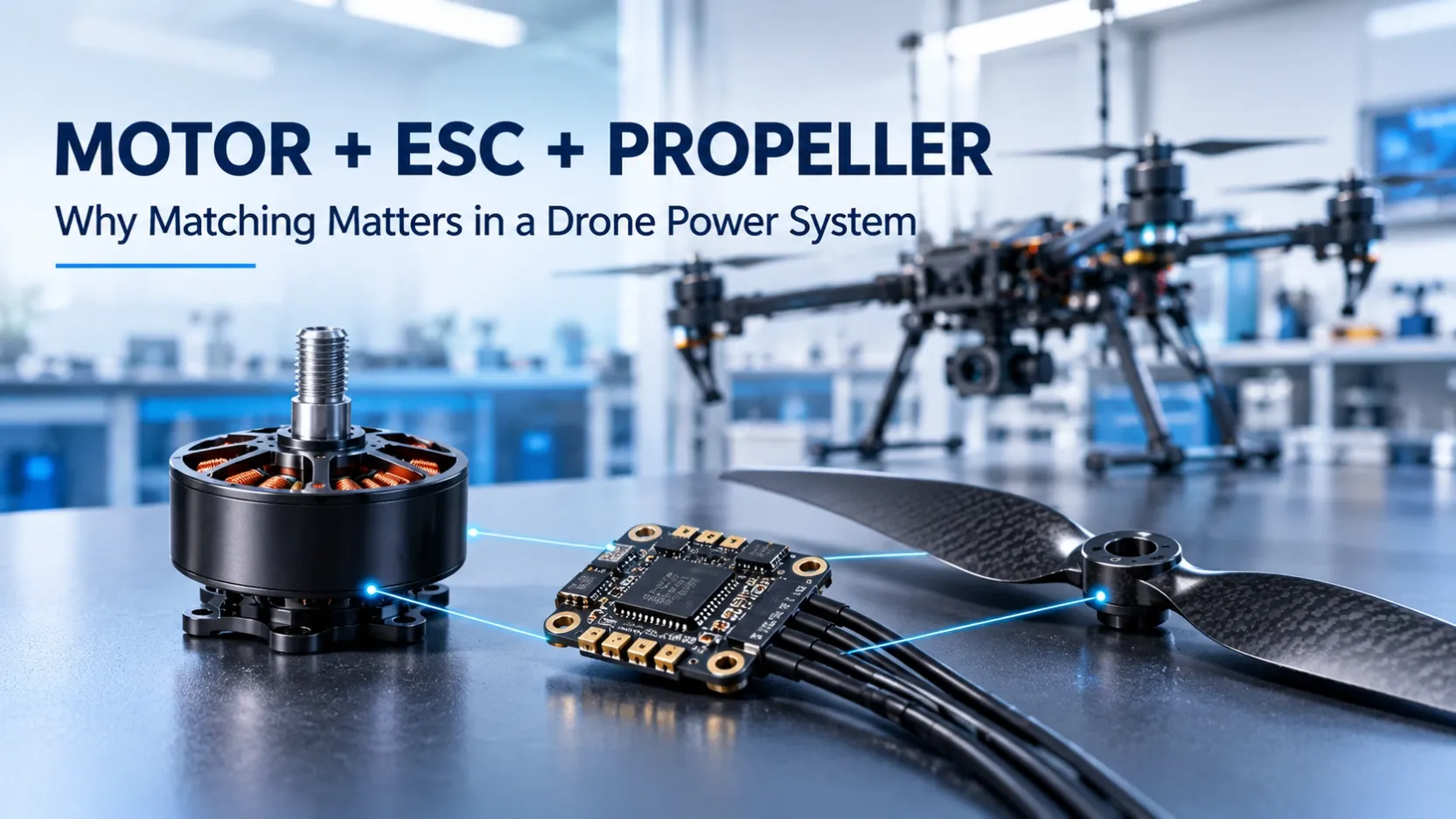
Why Motor, ESC and Propeller Matching Matters in a Drone Power System
Learn why brushless motors, ESCs and propellers need to work together. A practical guide for UAV manufacturers and drone component buyers.
Buying the Right Motor Is Only the First Step
When developing a drone, it is tempting to select the motor first and then look for a suitable ESC and propeller.
But this approach can create problems later.
A motor may have enough power on paper, yet the complete setup may draw too much current, generate excessive heat, or fail to deliver the expected flight performance.
The reason is simple: the motor, ESC, battery and propeller work as one system. Changing one component can affect the others.
For drone manufacturers and component buyers, checking compatibility before purchasing can save time and reduce unnecessary testing.
The Propeller Has More Influence Than You Might Expect
A propeller is not just an accessory attached to the motor.
Its diameter, pitch, blade count and design determine the load placed on the motor.
For example, changing to a larger or higher-pitch propeller can increase the load. The motor may then draw more current and produce more heat.
This does not mean a larger propeller is always better. The right choice depends on the motor's characteristics, battery voltage and aircraft requirements.
When requesting a motor recommendation, it is helpful to provide the exact propeller model or at least its diameter and pitch.
Choosing an ESC: Don't Look at the Amp Rating Alone
The ESC controls the motor's speed and must handle the current required by the complete setup.
A common mistake is to select an ESC based only on the motor's advertised maximum power.
In reality, current consumption changes with the propeller, voltage and operating conditions.
Before choosing an ESC, check:
- Motor current under the intended propeller load
- ESC continuous and burst current ratings
- Battery voltage compatibility
- Cooling and airflow
- Firmware and control protocol requirements
The continuous current rating is particularly important. A burst rating should not be treated as the current that the ESC can handle throughout an entire flight.
It is also worth checking the ESC manufacturer's recommended operating conditions rather than relying on the product name alone.
Battery Voltage Changes the Whole Setup
Battery voltage is another important part of motor and ESC matching.
A motor's KV rating indicates its approximate no-load RPM per volt. Using a different battery voltage changes its theoretical no-load speed, but actual performance also depends on the propeller load.
A setup designed for 4S should not automatically be assumed to work with 6S.
The motor, ESC, battery and propeller all need to be checked together.
For larger multirotor platforms, voltage selection also affects current requirements, wiring and power distribution.
Why Testing the Complete Setup Matters
Specifications are useful, but they cannot answer every question.
A motor tested with one propeller may behave differently with another. The same is true when battery voltage or cooling conditions change.
For a more meaningful comparison, ask for test data that includes:
Test item | Information to check |
|---|---|
Motor model | Exact model and KV |
Battery | Voltage and cell configuration |
Propeller | Diameter, pitch and blade count |
Thrust | Measured thrust |
Current | Current consumption |
Power | Input power |
Temperature | Motor temperature after testing |
For more demanding applications, testing should also consider the expected operating duration, not just a short full-throttle run.
A matched system should be evaluated under conditions that are as close as practical to the intended application.
What Should You Send to a Supplier?
If you are sourcing motors and ESCs for a new drone project, the following information can help a supplier make a more useful recommendation:
- Drone type and application
- Estimated takeoff weight
- Number of motors
- Battery voltage
- Propeller size and pitch
- Required thrust per motor
- Estimated order quantity
If you are still developing the aircraft, you can send the specifications currently available. The configuration can then be discussed and refined as the project progresses.
Final Thoughts
A good drone power system is not simply a collection of high-performance components.
The motor needs to work with the propeller. The ESC needs to handle the actual current. The battery needs to supply the required power.
Getting these components right from the beginning makes the development and sourcing process much easier.
At RUIJUE, we help customers source brushless motors and related drone power components from China. Whether you need FPV motors, multirotor motors, ESCs or other propulsion components, we can discuss product options based on your project specifications and available supply.
Have a motor and ESC configuration to check? Send us your battery voltage, propeller size and target thrust. Let's discuss a suitable setup.