Buying Guides
2207, 2306 or 2807? How to Choose the Right FPV Brushless Motor
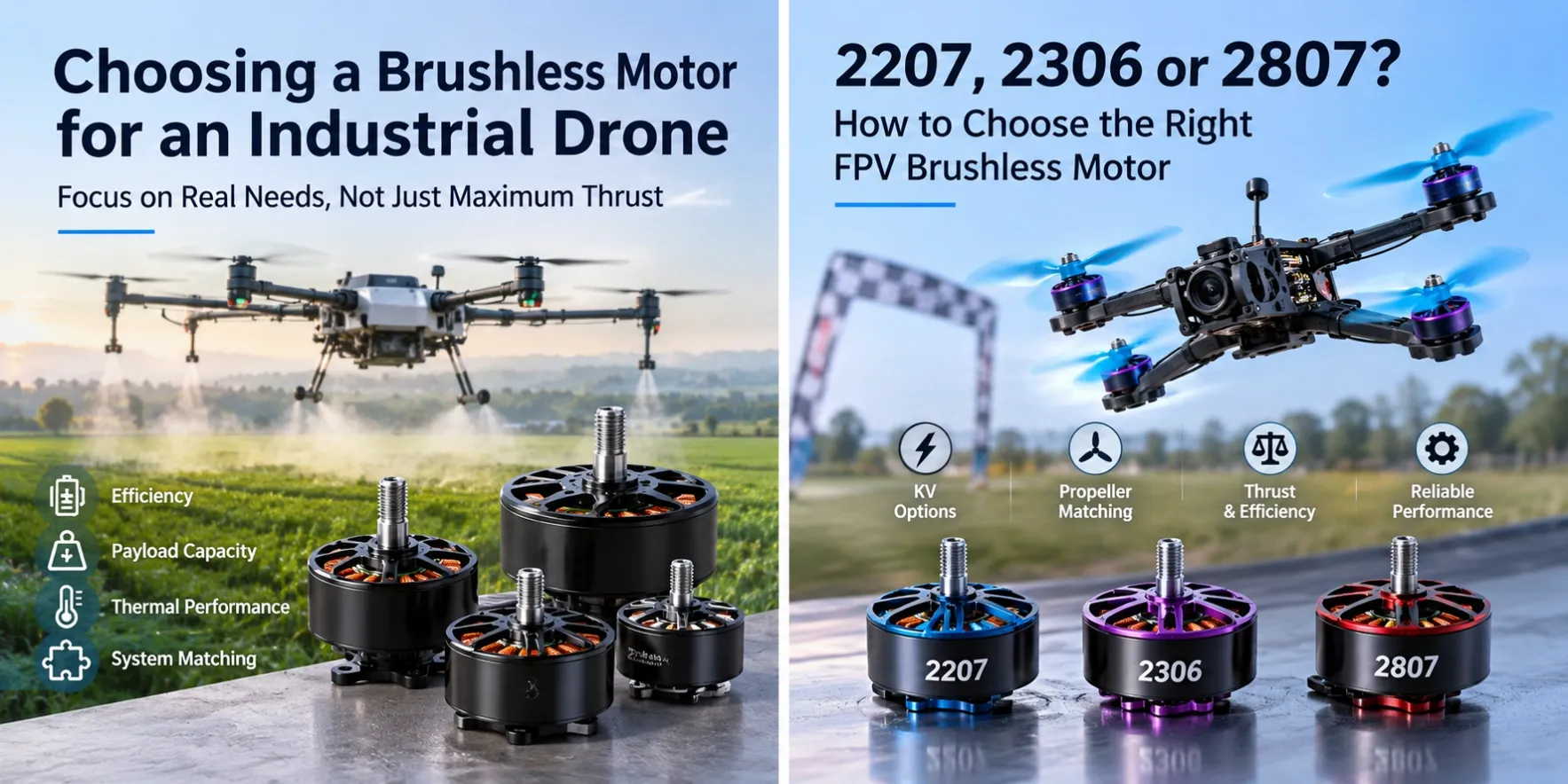
If you have been sourcing FPV motors, you have probably come across models such as 2207, 2306, 2806.5, and 2807.
At first glance, choosing between them may seem straightforward. Just compare the KV rating and price, then select the one that offers more power.
But this is not always how it works.
The same motor size can have different KV options, and even motors with identical specifications may perform differently depending on their internal design and the propeller being used.
So, what should you actually look at when choosing an FPV brushless motor?
2207 vs. 2306: Which One Should You Choose?
The 2207 and 2306 are two familiar motor sizes in the 5-inch FPV market.
The numbers describe the approximate stator diameter and height:
- 2207: 22 mm diameter, 7 mm height
- 2306: 23 mm diameter, 6 mm height
Both are widely used for 5-inch builds, but the difference in dimensions alone does not tell you which motor will perform better.
Winding design, magnet quality, motor weight, bearing quality, and manufacturing tolerances also matter.
For racing pilots, throttle response and acceleration may be the priority.
For freestyle pilots, the balance between power, control, durability, and flight time may be more important.
It is better to compare actual test results than choose a motor based only on its model number.
What About 2807 Motors for 7-Inch Drones?
When moving to a 7-inch platform, motor requirements change.
A larger propeller creates a different load, so the motor needs to be selected accordingly.
The 2807 is one of the motor sizes used in this type of build. Lower KV options are often considered for 6S long-range configurations, but the correct value depends on the propeller and the overall aircraft weight.
For long-range flying, many pilots care less about maximum acceleration and more about efficient cruising.
This means that a motor should be evaluated at the throttle range where the drone will spend most of its flight time, not just at full throttle.
Does Higher KV Mean More Power?
Not necessarily.
KV indicates the approximate no-load RPM per volt. It does not directly tell you how much thrust a motor can produce or how efficiently it operates.
For example, a 1,700KV motor supplied with a nominal 22.2V 6S battery has a theoretical no-load speed of around 37,740 RPM.
Once a propeller is installed, the actual RPM changes because the motor is working against a load.
A higher KV motor may provide a different response, but it can also draw more current depending on the propeller and battery configuration.
This is why KV should always be considered together with motor size, propeller, and voltage.
Don't Compare Motors by Thrust Alone
When comparing two FPV motors, ask for the test conditions.
Was the test performed with the same battery voltage? Was the same propeller used? Were the current and temperature recorded?
Without this information, two thrust figures may not be directly comparable.
For buyers and distributors, a complete test table is particularly useful when deciding which models to add to a product range.
It also helps avoid misunderstandings when customers use different propellers or battery configurations.
A Few Things Worth Checking Before Ordering
If you are purchasing FPV motors for your own brand or distribution business, I would suggest checking the following:
- Motor dimensions and mounting pattern
- KV options and recommended battery voltage
- Weight and wire specifications
- Recommended propeller range
- Maximum current and power under stated test conditions
- Bearing and shaft specifications
- Available colors, packaging, and customization options
For a first order, it can also be useful to test a small quantity before committing to larger volumes.
Final Thoughts
There is no single best FPV motor for every build.
A 2207 may be suitable for one 5-inch racing setup, while a 2306 or 2807 may make more sense for another application.
The important thing is to match the motor to the drone rather than choose based on KV or price alone.
We supply a range of brushless motors for FPV drones and other UAV applications, with product options and small-batch sourcing support depending on availability.
If you are looking for a particular motor size or KV rating, feel free to send us your requirements. We would be happy to discuss available options.
Looking for an FPV motor supplier in China? Contact RUIJUE to discuss your requirements.